How I Structure Modern Next.js Projects
12/07/2026
Every developer has a different way of organizing a Next.js project. After working on production applications and building my own SaaS projects, I’ve learned that the best folder structure isn’t the most complex one—it’s the one that’s easy to understand and maintain.
Over time, I’ve moved away from over-engineering and focused on keeping projects simple, scalable, and predictable. Here are the principles I follow.
1. Organize by Responsibility
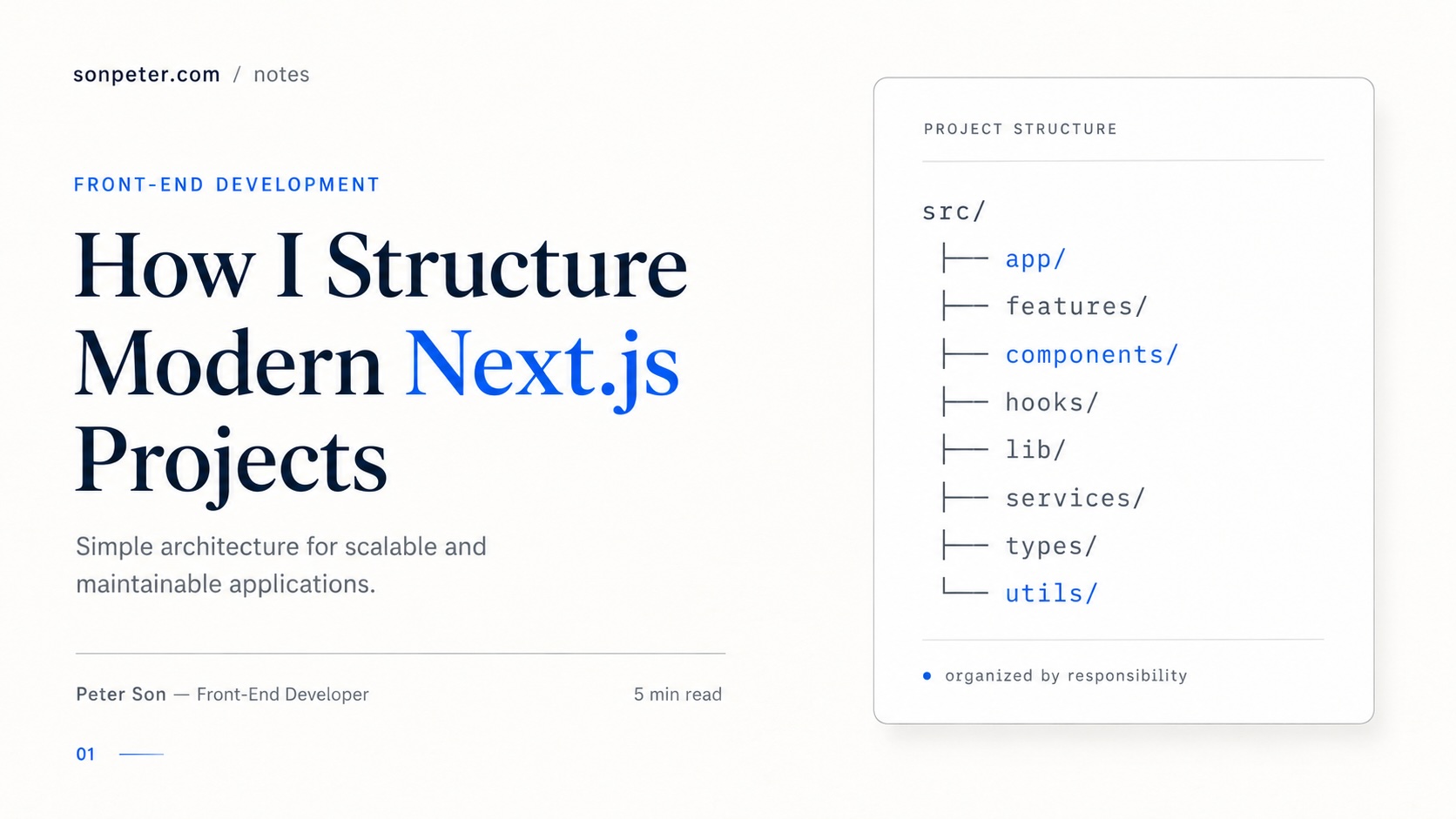
Rather than putting everything inside a single components folder, I separate code by its purpose.
src/
├── app/
├── features/
├── components/
├── hooks/
├── lib/
├── services/
├── types/
├── utils/
This makes it easier to find files, onboard new developers, and keep related code together as the project grows.
2. Keep Components Small
If a component becomes difficult to explain, it’s usually doing too much.
I prefer breaking large pages into smaller, reusable components that each have a single responsibility. Smaller components are easier to test, reuse, and maintain.
3. Build for Today, Refactor for Tomorrow
One mistake I made early on was trying to make every component reusable from day one.
Now I build the simplest solution first. Once I notice repeated patterns, I extract shared components or utilities. This keeps the codebase flexible without introducing unnecessary complexity.
4. Separate Business Logic from UI
Pages and components should focus on presenting the interface.
Data fetching, validation, and business logic belong in hooks, services, or utility functions. Keeping these concerns separate makes features easier to understand and modify.
5. Optimize for the Future
I always ask myself one question before committing code:
“Will this still make sense six months from now?”
Clean code isn’t about writing clever code. It’s about making future changes easier—for teammates, clients, and even my future self.
Final Thoughts
There isn’t a perfect folder structure that works for every project. The best structure is one your team can understand and use consistently.
For me, simplicity wins almost every time. A well-organized project makes development faster, reduces maintenance costs, and gives me confidence as applications continue to grow.
Thanks for reading! If you’re building a modern React or Next.js application, I’d love to hear how you approach project structure.